

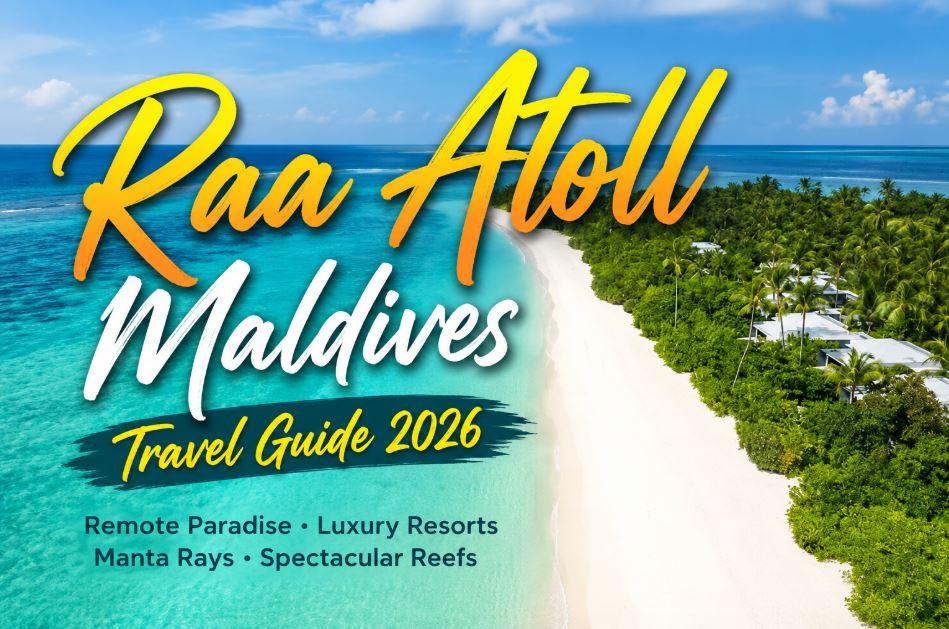
Far from the busier resort islands around Malé, Raa Atoll offers a quieter side of the Maldives — filled with turquoise lagoons, white-sand islands, thriving coral reefs and some of the country's most impressive luxury resorts.
Also known as Northern Maalhosmadulu Atoll, Raa Atoll is an excellent choice for travelers who want tropical seclusion without sacrificing world-class accommodation, diving, snorkeling and water sports.
Whether you're planning a honeymoon, family escape or underwater adventure, here's everything you need to know about visiting Raa Atoll in the Maldives in 2026.
Where Is Raa Atoll?
Raa Atoll is located in the northern Maldives, north of Baa Atoll and separated from it by the Hani Kandu channel.
The atoll stretches roughly 70 km from north to south and around 30 km across and consists of 88 islands, including 15 inhabited islands.
Its administrative capital is Ungoofaaru.
Because Raa Atoll lies considerably farther from Malé than destinations such as North Malé and South Malé Atoll, the atmosphere can feel noticeably more remote. Large stretches of ocean, uninhabited islands and isolated sandbanks help create the classic castaway experience many travelers imagine when dreaming about the Maldives.
Why Visit Raa Atoll?
The biggest attraction of Raa Atoll is its combination of luxury, natural beauty and relative isolation.
While development has brought several high-end resorts to the region, much of the atoll retains a wild tropical character.
Travelers can expect:
-
Powder-white tropical beaches
-
Brilliant turquoise lagoons
-
Luxury private-island resorts
-
Excellent house reefs
-
Manta ray encounters
-
Reef sharks and turtles
-
Scuba diving and snorkeling
-
Dolphin cruises
-
Fishing trips
-
Deserted-island excursions
-
Water sports
-
Local island experiences
Raa Atoll can be particularly appealing to repeat Maldives visitors searching for somewhere beyond the country's best-known tourism zones.
Raa Atoll's Incredible Underwater World
For divers and snorkelers, what lies beneath the Indian Ocean may be the strongest reason to visit.
Raa Atoll has distinctive underwater geography. Its outer ridge drops into deeper ocean while many islands within the atoll sit around shallower underwater plateaus.
These environments support coral reefs and an impressive variety of tropical marine life.
Divers can explore channels, reef walls, coral formations and underwater pinnacles, while snorkelers staying at resorts with good house reefs may encounter marine life just minutes from the beach.
Marine Life in Raa Atoll
Depending on the location and season, underwater encounters can include:
-
Manta rays
-
Reef sharks
-
Sea turtles
-
Eagle rays
-
Napoleon wrasse
-
Giant clams
-
Schools of tropical reef fish
-
Soft and hard corals
-
Pelagic species around deeper channels
The region is particularly interesting because visitors can experience both colorful reef ecosystems and larger marine species.
Manta Rays in Raa Atoll
Manta rays are among the most exciting animals visitors may encounter in Raa Atoll.
Conditions during the southwest monsoon can bring increased plankton concentrations to parts of the atoll, creating feeding opportunities for mantas.
August through November can be particularly interesting for travelers hoping for manta encounters, although wildlife sightings can never be guaranteed.
Some resorts and marine research programs in the region also participate in manta conservation and research, giving environmentally curious travelers opportunities to learn more about these extraordinary animals.
Scuba Diving in Raa Atoll
Raa Atoll deserves far more attention among divers.
Its channels can produce exciting drift dives, while submerged reefs and thilas attract large concentrations of fish.
Popular diving environments include:
Channel dives – Currents flowing through openings in the atoll can attract sharks, rays and schooling fish.
Thilas – Submerged pinnacles covered with corals provide shelter for reef fish and larger predators.
Outer reefs – Reef edges facing deeper Indian Ocean water provide opportunities for pelagic encounters.
House reefs – Several resort islands provide convenient reef access directly from or close to shore.
One advantage of staying at a resort with a strong house reef is being able to snorkel frequently without booking a boat excursion every day.
Snorkeling in Raa Atoll
You don't need scuba certification to appreciate Raa Atoll's underwater scenery.
Many islands are surrounded by shallow lagoons transitioning into coral reef systems where snorkelers can search for butterflyfish, parrotfish, surgeonfish, rays and turtles.
When choosing accommodation primarily for snorkeling, don't judge a resort solely by the appearance of its lagoon.
Check:
-
Distance from the beach to the reef
-
Number of house-reef entry points
-
Typical currents
-
Marine life around the island
-
Guided snorkeling availability
A beautiful turquoise lagoon does not automatically mean an equally accessible house reef.
Best Resorts in Raa Atoll
Raa Atoll has developed into one of the Maldives' notable luxury resort regions.
Properties range from romantic private-island retreats to larger resorts offering extensive dining, water sports, spas and family facilities.
Among the well-known luxury names associated with the atoll are JOALI Maldives, Emerald Maldives Resort & Spa, Furaveri Maldives and Kudafushi Resort & Spa.
Travelers should compare resorts based on more than villa prices.
Consider the quality of the house reef, transfer arrangements, meal plans, island size, children's facilities, diving opportunities and whether the atmosphere matches your style of holiday.
For honeymooners, privacy and overwater villas may be the priority.
Divers may care more about reef access and the dive center.
Families may prefer larger islands with swimming pools, kids' clubs and multiple restaurants.
Explore Raa Atoll's Local Islands
Resorts aren't the only side of Raa Atoll.
Its inhabited islands provide opportunities to discover everyday Maldivian island life away from private resort environments.
Ungoofaaru
Ungoofaaru is the administrative capital of Raa Atoll and an important population and service center for the region.
Visiting gives travelers a completely different perspective from staying on a private resort island.
Alifushi
Alifushi has a long connection with traditional Maldivian boat building.
Boat building remains an important part of Maldivian maritime culture, making islands associated with the craft particularly interesting for travelers who want to understand the country's relationship with the sea.
Meedhoo
Meedhoo is another inhabited island that may feature on cultural excursions organized by nearby resorts.
Such trips can offer a glimpse into residential streets, harbors, mosques and the everyday rhythm of island communities.
Remember that local islands follow Maldivian customs and regulations. Visitors should dress respectfully away from designated tourist beach areas.
Deserted Islands and Sandbanks
One of the pleasures of being in a relatively remote atoll is escaping to an island where there appears to be almost nobody else around.
Raa Atoll contains numerous uninhabited islands and tiny sandbanks.
Resorts may organize private or small-group excursions where travelers can spend several hours swimming, snorkeling, picnicking or simply relaxing on an isolated beach.
For couples, a private sandbank experience around sunset can become one of the most memorable moments of a Maldives honeymoon.
Dolphin Cruises
The waters surrounding Raa Atoll are also home to dolphins.
Many resorts organize dolphin cruises, typically during the afternoon or around sunset.
Sightings aren't guaranteed because dolphins are wild animals, but encountering a pod racing alongside a boat against a tropical sunset can be unforgettable.
Fishing in Raa Atoll
Fishing has supported Maldivian island communities for generations.
Raa Atoll's proximity to deeper waters makes fishing excursions another popular activity.
Resorts may offer traditional sunset fishing as well as more specialized fishing trips.
Even travelers who aren't serious anglers can enjoy a traditional Maldivian fishing excursion as a cultural experience.
Water Sports
The calm lagoons surrounding many resort islands provide excellent conditions for water sports.
Depending on the resort, activities may include:
-
Kayaking
-
Stand-up paddleboarding
-
Jet skiing
-
Windsurfing
-
Catamaran sailing
-
Parasailing
-
Wakeboarding
-
Water skiing
Non-motorized activities are sometimes included in resort packages, while motorized sports normally cost extra.
Best Time to Visit Raa Atoll
Raa Atoll can be visited throughout the year, but conditions change with the Maldives' monsoon seasons.
December to April – Best for Sunshine
The northeast monsoon generally brings the driest and sunniest conditions.
Expect:
-
More sunshine
-
Lower rainfall
-
Calmer weather
-
Excellent beach conditions
-
Good underwater visibility
This is also peak Maldives travel season, so accommodation prices can be higher, especially around Christmas, New Year and Easter.
May to November – Great for Marine Life and Value
The southwest monsoon typically brings increased humidity, clouds, wind and occasional heavy showers.
However, this period has significant advantages.
Resorts frequently offer better prices, the islands are less crowded, and seasonal plankton movements can improve opportunities for encounters with manta rays in parts of the northern Maldives.
Rain doesn't necessarily mean entire days are lost. Tropical showers can be intense but short, followed by sunshine.
How to Get to Raa Atoll
Raa Atoll is significantly north of Velana International Airport, so travelers normally continue their journey by seaplane or domestic flight followed by a speedboat transfer.
Seaplane
A direct seaplane journey from the Malé area generally takes around 45 minutes, depending on the resort and routing.
For first-time visitors, the journey itself is spectacular.
Flying over the Maldives reveals rings of coral reefs, turquoise lagoons and tiny islands scattered across the Indian Ocean.
Domestic Flight
Another option is a domestic flight connecting the Malé area with airports serving the region, including Ifuru Airport.
Some itineraries can also use Dharavandhoo Airport in neighboring Baa Atoll, followed by an onward speedboat journey.
The exact route depends on your resort.
Always confirm transfers with your accommodation before booking separate domestic transportation.
Raa Atoll vs Baa Atoll
Travelers often compare Raa Atoll with neighboring Baa Atoll.
Baa Atoll is internationally famous for the UNESCO Biosphere Reserve and Hanifaru Bay, making it especially popular among travelers hoping to see large seasonal manta aggregations.
Raa Atoll, meanwhile, can feel quieter and more remote while still offering excellent diving, snorkeling and manta opportunities.
Choose Baa Atoll if Hanifaru Bay is one of the main objectives of your trip.
Choose Raa Atoll if you're attracted to remote luxury resorts, beautiful reefs and a quieter northern Maldives atmosphere.
Both can deliver extraordinary holidays.
Is Raa Atoll Good for Honeymoons?
Absolutely.
Raa Atoll has virtually every ingredient associated with a Maldives honeymoon: remote islands, overwater villas, private pools, turquoise lagoons and spectacular sunsets.
Its distance from Malé can actually be an advantage.
Once you reach your resort, the surroundings often feel wonderfully removed from the outside world.
Couples can arrange private dinners, sunset cruises, spa treatments, sandbank picnics and snorkeling excursions.
Is Raa Atoll Good for Families?
Yes.
Although some properties emphasize romance and privacy, several resorts cater exceptionally well to families.
Look for resorts offering:
-
Kids' clubs
-
Family villas
-
Shallow swimming lagoons
-
Children's pools
-
Babysitting
-
Family snorkeling trips
-
Water sports
-
Multiple restaurants
Because transfers can add considerable travel time after an international flight, families with very young children should compare seaplane and domestic-flight schedules carefully.
How Many Days Do You Need in Raa Atoll?
For most travelers, five to seven nights provides enough time to enjoy the resort while fitting in several excursions.
A seven-night itinerary might include snorkeling, a diving or manta excursion, dolphin cruise, spa day, water sports and plenty of unstructured beach time.
Travelers flying long distances to reach the Maldives may prefer 7–10 nights, especially because getting to Raa Atoll requires an additional transfer from the Malé area.
Is Raa Atoll Worth Visiting?
For travelers seeking a more secluded Maldives experience, Raa Atoll is absolutely worth considering.
Its combination of beautiful islands, impressive resorts, healthy marine ecosystems, manta encounters and excellent diving gives it broad appeal.
The longer transfer from Malé is the main trade-off.
But that distance is also part of its attraction.
Once the seaplane descends toward an isolated island surrounded by brilliant turquoise water, Raa Atoll feels exactly like the remote Indian Ocean paradise many travelers came to the Maldives hoping to find.
Frequently Asked Questions About Raa Atoll
Where is Raa Atoll located?
Raa Atoll is in the northern Maldives, immediately north of Baa Atoll. It is also known as Northern Maalhosmadulu Atoll.
How many islands are in Raa Atoll?
Raa Atoll contains 88 islands, of which 15 are inhabited.
What is the capital of Raa Atoll?
Ungoofaaru is the administrative capital of Raa Atoll.
How long does it take to reach Raa Atoll from Malé?
A seaplane journey generally takes around 45 minutes, although actual journey times vary by resort and routing. Domestic flights followed by speedboat transfers are another option.
Is Raa Atoll good for snorkeling?
Yes. Raa Atoll has coral reefs, tropical fish, turtles, rays and other marine life. Several resort islands also have accessible house reefs.
Can you see manta rays in Raa Atoll?
Yes. Manta rays visit parts of Raa Atoll seasonally, with particularly interesting opportunities during the southwest monsoon. However, sightings are never guaranteed.
What is the best time to visit Raa Atoll?
December through April generally offers the driest weather and abundant sunshine. The May-November period can offer lower resort prices and interesting marine-life encounters, including seasonal manta activity.
Is Raa Atoll good for diving?
Yes. Raa Atoll offers channel dives, reef walls, thilas and house reefs inhabited by reef sharks, rays, turtles and large schools of tropical fish.
Is Raa Atoll suitable for a honeymoon?
Yes. Its remote setting, private-island resorts, overwater villas and secluded beaches make Raa Atoll particularly attractive for honeymooners and couples.
Is Raa Atoll better than Baa Atoll?
Neither is universally better. Baa Atoll is especially famous for Hanifaru Bay and its UNESCO Biosphere Reserve, while Raa Atoll appeals to travelers seeking remote luxury, excellent reefs and a quieter atmosphere.
Final Thoughts
Raa Atoll is one of the Maldives' most compelling northern escapes.
It delivers everything travelers dream about when imagining the Maldives — impossibly blue lagoons, white beaches, overwater villas and coral reefs — but wraps those experiences in a setting that can feel considerably more secluded than the islands closer to Malé.
For honeymooners, divers, snorkelers, families and luxury travelers, Raa Atoll deserves a place high on the Maldives travel shortlist.

 Dhivehi
 English
 Arabic
 French
 Spanish
 Portuguese
 Deutsch
 Turkish
 Dutch
Dutch
 Italiano
 Russian
 Romaian
 Portuguese (Brazil)