

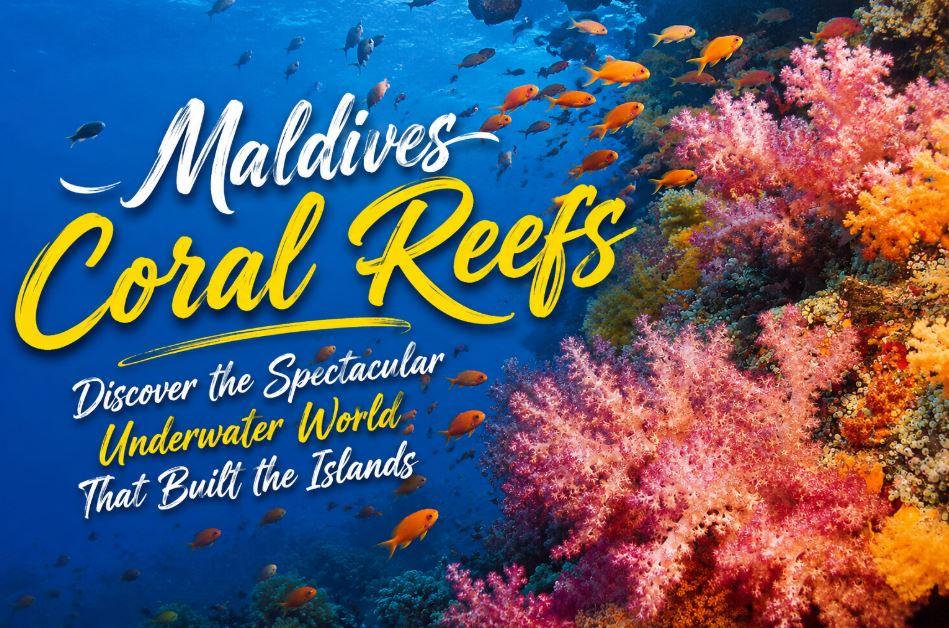
Few destinations are as closely connected to coral reefs as the Maldives. Beneath its turquoise lagoons lies an enormous living ecosystem filled with hard corals, soft corals, reef fish, turtles, rays and countless other marine creatures.
For snorkelers and scuba divers, exploring a Maldives coral reef is one of the highlights of any island holiday. But these reefs are much more than beautiful dive sites—they helped create the islands themselves and continue to protect them from the power of the Indian Ocean.
Why Are the Coral Reefs of the Maldives So Special?
The Maldives is essentially a coral reef nation.
Its islands are grouped into natural atolls stretching across the Indian Ocean, surrounded by reefs, lagoons, channels and deep ocean.
Maldivian authorities estimate the country's reef area at roughly 4,500 square kilometres, making it one of the world's significant coral reef systems. The reefs are also fundamental to tourism, fisheries and the physical protection of the country's low-lying islands.
For visitors, this extraordinary geography means you don't always need to travel far to experience marine life. Many resorts and local islands have house reefs accessible directly from the beach, while dive boats can reach outer reefs, channels, pinnacles and other underwater formations.
What Exactly Is Coral?
One of the biggest misconceptions about coral is that it is a plant or colorful underwater rock.
Corals are animals.
A coral colony consists of tiny organisms called polyps. Reef-building corals produce hard calcium carbonate skeletons, which gradually accumulate and contribute to the formation of enormous reef structures.
Many tropical corals also have a remarkable relationship with microscopic algae living within their tissues.
These algae use sunlight to photosynthesize and provide energy to their coral hosts. In return, the coral provides the algae with shelter and nutrients.
This relationship is one of the reasons sunlight is so important to shallow tropical coral reefs.
How Did the Maldives Coral Reefs Form?
The story of the Maldives began millions of years ago and is closely connected with ancient volcanic activity.
Corals grew around submerged geological structures, gradually developing into enormous reef systems.
As the underlying formations subsided, corals continued growing toward sunlight near the ocean surface.
Over immense periods of time, ring-shaped reef structures developed around lagoons.
These formations are known as atolls.
Sand, broken coral material and other sediments accumulated in certain areas of the reefs, eventually forming the small islands that today make up the Maldives.
This means the spectacular islands travelers see above water are inseparable from the reef ecosystem beneath them.
What You'll See on a Maldives Coral Reef
Drop beneath the surface and the seemingly simple blue lagoon suddenly becomes a busy underwater city.
Healthy reef environments can contain branching corals, massive boulder-like corals, table-shaped formations, soft corals and sea fans.
Around them, visitors may encounter:
-
Butterflyfish
-
Angelfish
-
Parrotfish
-
Surgeonfish
-
Triggerfish
-
Moorish idols
-
Wrasses
-
Groupers
-
Moray eels
-
Anemonefish
-
Reef sharks
-
Stingrays
-
Eagle rays
-
Sea turtles
Every reef is different.
Some areas are dominated by colorful reef fish and coral gardens, while others are famous for dramatic drop-offs, strong currents and encounters with larger marine species.
Hard Corals vs Soft Corals
Visitors will generally encounter two broad visual groups of coral.
Hard Corals
Hard or stony corals are the principal reef-building corals.
Their calcium carbonate skeletons create the physical structure of the reef over long periods.
Common shapes include branching, massive, table and plate-like formations.
These structures provide hiding places, feeding areas and nurseries for numerous marine animals.
Soft Corals
Soft corals don't produce the same massive hard skeletons as reef-building corals.
Instead, they often sway with the current, creating spectacular underwater scenery.
Certain Maldivian dive sites are particularly beautiful when currents bring nutrient-rich water across areas covered with soft corals.
Why Maldives Coral Reefs Are Amazing for Scuba Diving
The Maldives has become internationally famous for diving because reefs interact with the open Indian Ocean in fascinating ways.
Ocean currents flow through channels between atolls and islands, carrying nutrients and attracting marine life.
Divers can experience everything from relaxed coral gardens to exhilarating current dives.
Underwater landscapes include reef walls, overhangs, channels and submerged pinnacles locally known as thilas.
A single dive might reveal schools of tropical fish around the reef before a turtle, eagle ray or reef shark suddenly appears in the blue.
That unpredictability is a major part of the Maldives diving experience.
Snorkeling the Coral Reefs
You don't have to be a certified scuba diver to enjoy the reefs.
Snorkeling is one of the easiest ways to discover the underwater world of the Maldives.
Many islands have shallow lagoons leading toward a reef edge where the seabed suddenly drops into deeper water.
These house reefs can provide excellent opportunities to see reef fish and other marine creatures only minutes after entering the ocean.
When choosing accommodation specifically for snorkeling, look beyond the appearance of the beach.
An island with an easily accessible and healthy house reef can offer a dramatically better snorkeling experience than an island surrounded primarily by a wide sandy lagoon.
Best Time to Explore Maldives Coral Reefs
Coral reefs can be explored throughout the year, but underwater conditions vary with the monsoons.
The northeast monsoon period, broadly associated with the drier part of the year, often brings calmer weather and excellent visibility in many areas.
The southwest monsoon can bring more clouds, rain and changing underwater visibility, but nutrient-rich conditions may also increase marine activity in particular regions.
There is therefore no single perfect month for every reef or every type of marine encounter.
Your ideal season depends on the atoll, dive site and animals you hope to see.
Coral Bleaching in the Maldives
Despite their beauty, Maldivian coral reefs face serious environmental pressure.
One of the greatest threats is coral bleaching caused by unusually high sea temperatures.
Corals live within a relatively narrow environmental range. When prolonged heat places them under severe stress, they can expel the microscopic algae living inside their tissues.
The coral then loses much of its color and appears pale or white—a phenomenon known as bleaching.
Bleached coral isn't necessarily dead.
If conditions improve quickly enough, some corals can recover. However, prolonged or repeated thermal stress can result in significant coral mortality.
The Maldives has experienced major bleaching events in its modern history. Government climate reporting identifies rising sea-surface temperatures and associated coral bleaching and mortality among the major climate-related threats facing the country's reefs.
Why Protecting Maldives Coral Reefs Matters
Coral conservation isn't only about preserving beautiful snorkeling and diving sites.
The reefs are fundamental to the Maldives itself.
They provide habitat for marine life, support fisheries and tourism, and help protect islands from waves and storms.
For a nation composed of extremely low-lying islands, maintaining resilient reef ecosystems has enormous environmental and economic importance.
Climate change remains the largest long-term challenge, but local pressures—including coastal development, pollution and physical damage—can also affect reef health.
How Tourists Can Help Protect the Reef
Visitors can make a meaningful difference through simple responsible behavior.
Never stand on coral. Even apparently solid coral structures can contain delicate living tissue.
Don't touch marine life. Observe animals without chasing, grabbing or feeding them.
Maintain good buoyancy while diving. Divers should keep fins and equipment away from the reef.
Don't collect coral or shells from the reef. Leave the ecosystem exactly as you found it.
Choose responsible dive and excursion operators. Professional operators should prioritize reef protection and responsible wildlife encounters.
Reduce unnecessary plastic waste. Preventing rubbish from reaching the ocean benefits the entire marine environment.
The best souvenir from a Maldives reef is a photograph—not a piece of the reef itself.
Coral Reefs Are the Heart of the Maldives
The Maldives wouldn't be the destination we know today without coral reefs.
They created the foundation for its islands, shelter an extraordinary variety of marine life and provide some of the most memorable snorkeling and scuba-diving experiences in the Indian Ocean.
Floating above a shallow coral garden surrounded by tropical fish can be beautiful. Descending along a reef wall with rays or sharks passing in the blue can be unforgettable.
But perhaps the most impressive realization is that the reef isn't simply another attraction in the Maldives.
The reef is what made the Maldives possible.
Frequently Asked Questions About Maldives Coral Reefs
Are there coral reefs everywhere in the Maldives?
Coral reefs occur throughout the Maldivian archipelago. However, reef accessibility, coral cover, underwater topography and marine life vary considerably between islands and atolls.
Is Maldives coral good for snorkeling?
Yes. The Maldives is one of the world's best-known tropical snorkeling destinations. Islands with accessible house reefs are particularly convenient because visitors can snorkel directly from shore.
Do I need to scuba dive to see coral?
No. Many coral reefs occur in shallow water and can be explored while snorkeling. Scuba diving allows visitors to explore deeper reef walls, pinnacles and channels.
Is coral a plant or an animal?
Coral is an animal. Individual coral organisms are called polyps, and many tropical reef-building corals live in partnership with microscopic photosynthetic algae.
Can I touch coral while snorkeling?
No. Avoid touching, standing or walking on coral. Physical contact can damage living coral tissue, and some marine organisms can also cause cuts or stings.
What is coral bleaching?
Coral bleaching occurs when stressed corals lose the microscopic algae living within their tissues. High ocean temperatures are one of the principal causes. Bleached coral can sometimes recover, but prolonged stress can cause mortality.
What is a Maldives house reef?
A house reef is the reef surrounding or located close to an island or resort. On islands with good access, guests may be able to reach the reef directly from the beach or designated snorkeling entrances.
What is a thila in the Maldives?
A thila is a submerged reef or pinnacle. Many famous Maldivian dive sites are thilas because currents flowing around them can attract abundant fish and other marine life.
Why are coral reefs important to the Maldives?
Coral reefs support marine biodiversity, tourism and fisheries while also helping protect low-lying islands from waves and storms. They are fundamental to both the environment and economy of the Maldives.
Are Maldives coral reefs threatened by climate change?
Yes. Rising sea temperatures, coral bleaching, ocean-related climate impacts and other environmental pressures pose significant threats to Maldivian reefs. Protecting reefs and reducing additional local stresses can improve their ability to withstand environmental change.

 Dhivehi
 English
 Arabic
 French
 Spanish
 Portuguese
 Deutsch
 Dutch
Dutch
 Italiano
 Russian
 Romaian
 Portuguese (Brazil)
 Greek
Greek