

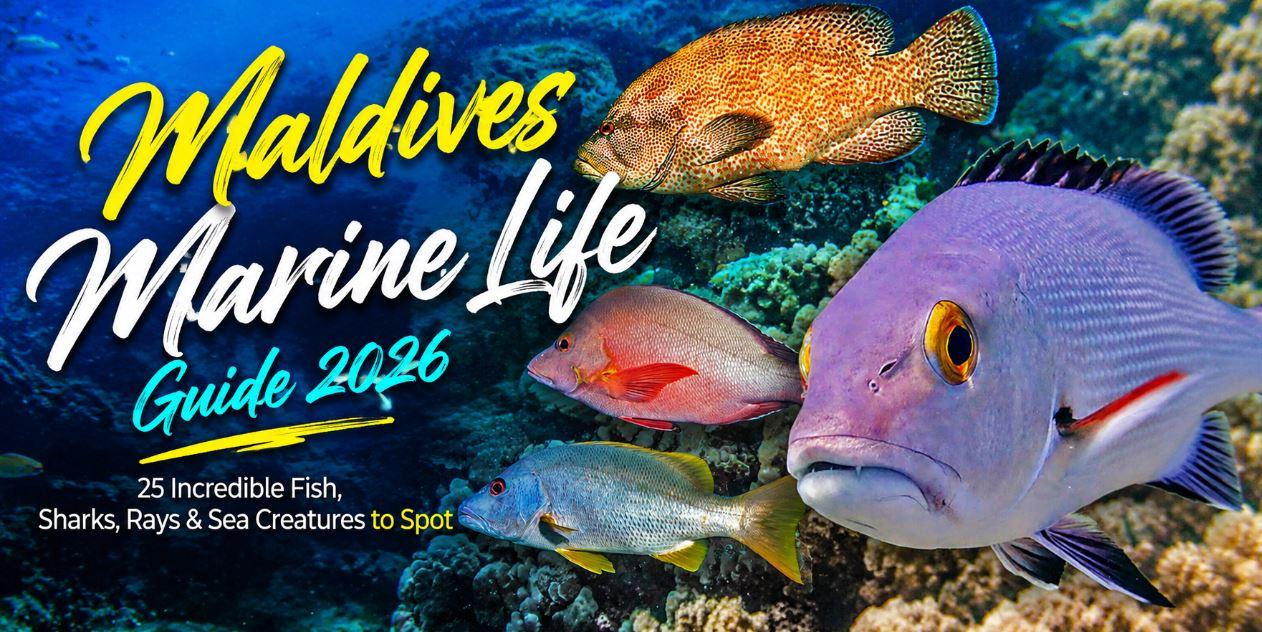
The Maldives may be famous for white-sand beaches and turquoise lagoons, but the real magic begins beneath the surface.
With around 1,100 known fish species, warm tropical waters and coral reefs spread across 26 natural atolls, the Maldives is one of the most exciting destinations in the world for snorkeling and scuba diving. From tiny anemonefish hiding among tentacles to enormous whale sharks cruising through the blue, almost every underwater trip can deliver a memorable encounter.
Here are some of the most spectacular fish and marine animals you can look for during a Maldives holiday.
Maldives Marine Life at a Glance
Best for: Tropical reef fish, sharks, manta rays, whale sharks, turtles and rays
Water temperature: Generally warm throughout the year
Activities: Snorkeling, scuba diving and marine-life excursions
Best experience: Choose an island with a good house reef or join guided boat trips to nearby reefs and channels
Marine-life season: Excellent year-round, although some major species have seasonal hotspots
1. Whale Shark
Few underwater encounters compare with seeing a whale shark in the Maldives.
Despite its enormous size, the whale shark is a filter-feeding fish rather than the fearsome predator its name might suggest. Seeing one slowly cruising through clear tropical water is often the highlight of an entire Maldives holiday.
South Ari Atoll is particularly famous for whale shark encounters, and the animals can be seen in the region throughout the year.
For the best experience, keep a respectful distance, never touch or chase the animal and follow the instructions of your guide.
2. Manta Ray
Manta rays are among the Maldives' most graceful underwater residents.
Their enormous wing-like fins allow them to glide effortlessly through the ocean, sometimes passing remarkably close to snorkelers and divers.
Mantas frequently gather around feeding areas and cleaning stations. Baa Atoll is especially famous for seasonal manta activity, while other atolls also offer excellent opportunities to encounter them.
Watching several mantas circle through plankton-rich water is one of the Maldives' signature wildlife experiences.
3. Blacktip Reef Shark
Look into the shallow lagoon around many Maldivian islands and you may spot a small shark cruising near the beach.
It is often a blacktip reef shark.
Recognizable by the dark markings on its fins, this species commonly inhabits shallow reefs and lagoons. Juveniles can sometimes be observed from jetties and beaches without even entering the water.
They generally avoid swimmers and are fascinating animals to watch from a respectful distance.
4. Whitetip Reef Shark
Whitetip reef sharks are another familiar sight for Maldives divers.
Unlike some shark species that must constantly swim, whitetips can often be found resting beneath coral ledges or inside caves during the day.
On dives, you may also see them cruising close to the reef in search of food.
Their slender bodies and distinctive white-tipped dorsal and tail fins make them relatively easy to recognize.
5. Grey Reef Shark
For divers who want a more dramatic shark encounter, the grey reef shark is one of the Maldives' underwater stars.
These powerful sharks are frequently associated with channels, reef edges and areas where currents bring nutrient-rich water into the atolls.
Experienced divers may encounter several sharks patrolling the blue during a single channel dive.
6. Nurse Shark
Nurse sharks have become one of the most recognizable marine animals in the Maldives.
They are usually slow-moving and may rest on sandy areas, underneath reef overhangs or near the seabed.
Some locations are known for gatherings of multiple nurse sharks, creating spectacular underwater scenes.
As with all wildlife encounters, divers and snorkelers should avoid touching, feeding or surrounding them.
7. Eagle Ray
A spotted eagle ray moving through clear Maldivian water looks almost like a bird flying through the sky.
Their distinctive spotted bodies and long tails make them easy to identify.
Eagle rays can appear individually or in groups, particularly around reef edges and channels. Because they often swim through open water, divers sometimes get excellent opportunities to watch them from below.
8. Stingray
Stingrays are frequently found around sandy lagoons and reef flats.
Their flattened bodies help them blend into the seabed, so snorkelers should avoid standing on coral or sandy areas where rays or other marine animals may be resting.
Watching a stingray glide just above the sand is a beautiful sight, especially in the clear shallow lagoons surrounding many islands.
9. Sea Turtle
Sea turtles are among the most loved animals in the Maldives.
Both snorkelers and scuba divers can encounter turtles around healthy coral reefs and feeding areas. Hawksbill turtles are particularly associated with reefs, where they search among corals for food.
Some islands have resident turtles that can be spotted regularly along their house reefs.
Never chase or touch a turtle. Give it plenty of room, particularly when it swims toward the surface to breathe.
10. Titan Triggerfish
The titan triggerfish is beautiful, large and full of personality.
It is also one reef fish that divers should give extra space.
Titan triggerfish can become territorial, particularly when protecting nesting areas. If one begins behaving defensively, calmly swim away from the area rather than approaching it.
Their distinctive shape, powerful jaws and bold markings make them one of the Maldives' most memorable reef fish.
11. Oriental Sweetlips
Oriental sweetlips are striking reef fish with bold patterns that change as they mature.
Adults are commonly seen around coral formations, overhangs and reef slopes.
They often remain relatively still compared with fast-moving schooling fish, giving underwater photographers excellent opportunities for photographs.
12. Bannerfish
With bold black-and-white stripes, yellow highlights and an elongated dorsal filament, bannerfish look made for underwater photography.
They can be encountered around coral reefs, sometimes swimming in pairs or groups.
Their elegant appearance makes them one of the classic tropical fish visitors associate with Maldives snorkeling.
13. Anemonefish
You don't need to find a giant shark to have an unforgettable underwater encounter.
Tiny anemonefish, commonly called clownfish, are among the most entertaining reef residents.
They live closely with sea anemones, darting between the protective tentacles whenever something approaches.
Because they can occur in relatively shallow water, snorkelers as well as divers may get the chance to observe them.
14. Parrotfish
Listen carefully while snorkeling over a quiet reef and you may even hear parrotfish feeding.
These colorful reef inhabitants use powerful teeth to scrape algae and other material from reef surfaces.
Depending on the species, their bodies can display brilliant combinations of turquoise, green, blue, pink and yellow.
Large parrotfish are especially impressive when encountered on a healthy reef.
15. Surgeonfish
Surgeonfish are another common sight around Maldivian coral reefs.
Some species gather in large schools, creating spectacular walls of moving fish.
Powder-blue surgeonfish are particularly photogenic and instantly recognizable to many snorkelers.
Their name comes from sharp defensive spines near the tail, another reminder that wild reef animals should be admired without touching them.
16. Butterflyfish
Butterflyfish add flashes of yellow, white, black and orange to Maldivian reefs.
Several species can be encountered around coral-rich areas, including the beautifully patterned collared butterflyfish.
They are often seen swimming in pairs close to coral formations.
For snorkelers exploring a shallow house reef, butterflyfish are among the species most worth watching for.
17. Angelfish
Angelfish are another group of beautifully patterned tropical reef fish.
Their compressed bodies allow them to maneuver around coral structures, while their bright markings make them easy to notice against the reef.
The threespot angelfish is among the species visitors may encounter in Maldivian waters.
18. Moray Eel
Look carefully into holes and crevices and you may find a moray eel staring back.
Morays spend much of their time partially concealed within the reef.
Seeing one repeatedly open and close its mouth can look threatening, but this behavior helps move water across its gills.
Never place your hands into reef holes or attempt to touch a moray.
19. Lionfish
Lionfish are among the most visually dramatic fish on the reef.
Their striped bodies are surrounded by long, fan-like fins and venomous spines.
They are wonderful subjects for underwater photography but should always be given plenty of space.
Divers should never attempt to touch or handle them.
20. Napoleon Wrasse
The Napoleon wrasse, also called the humphead wrasse, is one of the giants of the coral reef.
Large individuals can be an unforgettable sight, particularly when they slowly cruise past divers along reef slopes and cleaning areas.
Their size, thick lips and distinctive forehead make mature Napoleon wrasse unmistakable.
Encountering one is often a highlight for experienced Maldives divers.
21. Barracuda
Barracuda add a little drama to the underwater landscape.
Individual fish can be seen hovering almost motionless in the water, while large schools sometimes form impressive swirling formations.
Their streamlined silver bodies are perfectly adapted for speed.
For underwater photographers, a large school of barracuda can produce one of the most dramatic wide-angle scenes in the Maldives.
22. Fusiliers
Want to experience the famous feeling of being surrounded by fish?
Look for fusiliers.
Huge schools can gather around reefs and current-swept dive sites, filling the water column with flashes of blue, yellow and silver.
When predators such as tuna or trevallies appear, the entire school may suddenly change direction at once.
It's an extraordinary spectacle.
23. Snapper
Schools of snapper are another familiar sight around Maldivian reefs.
They often congregate near reef structures, pinnacles and overhangs, sometimes forming dense groups that are ideal for underwater photography.
Their bright colors contrast beautifully with blue water and coral backgrounds.
24. Dolphins
Although dolphins aren't fish, no Maldives marine-life guide would feel complete without them.
Pods are regularly spotted from boats while traveling between islands, resorts and dive sites.
A simple transfer across an atoll can unexpectedly become a wildlife excursion when dolphins begin swimming alongside the boat or leaping through its wake.
25. Jellyfish
Jellyfish are occasionally encountered in Maldivian waters, with their abundance varying according to currents and environmental conditions.
Most visitors will simply admire them from a distance.
Avoid touching unidentified jellyfish because some species can sting.
Where Can You See the Most Marine Life in the Maldives?
One of the advantages of the Maldives is that you don't necessarily need to be an experienced scuba diver to see impressive marine life.
A good house reef can provide encounters with butterflyfish, parrotfish, surgeonfish, moray eels, turtles, rays and reef sharks just a short swim from shore.
Scuba diving expands the possibilities.
Channels and deeper reef edges can produce encounters with grey reef sharks, eagle rays, tuna, barracuda and large schools of fish, while specialized excursions target manta rays and whale sharks.
Different atolls offer different highlights.
South Ari Atoll is particularly famous for whale sharks.
Baa Atoll is internationally known for seasonal manta ray gatherings.
North and South Malé Atolls combine accessible reefs, channels, wrecks and abundant reef life.
Vaavu Atoll is famous among divers for shark-rich channel diving.
Fuvahmulah offers a very different experience, attracting experienced divers looking for encounters with large pelagic animals.
Snorkeling vs Scuba Diving: Which Is Better for Marine Life?
You don't necessarily have to scuba dive to experience the best of the Maldives.
Snorkeling
Snorkeling is ideal for seeing:
-
Reef fish
-
Juvenile reef sharks
-
Sea turtles
-
Stingrays
-
Moray eels
-
Anemonefish
-
Parrotfish
-
Butterflyfish
-
Surgeonfish
Choose accommodation with direct access to a healthy house reef for the easiest experience.
Scuba Diving
Diving opens up deeper reefs, channels, pinnacles and cleaning stations where you may encounter:
-
Grey reef sharks
-
Whitetip reef sharks
-
Eagle rays
-
Napoleon wrasse
-
Barracuda
-
Large schools of snapper and fusiliers
-
Manta rays
-
Whale sharks
-
Other pelagic species
For serious marine-life enthusiasts, combining snorkeling and scuba diving provides the most complete Maldives experience.
When Is the Best Time to See Marine Life in the Maldives?
There is marine life to see throughout the year.
However, currents, monsoons, plankton concentrations and local conditions influence where particular species are most likely to gather.
This is especially important if your main goal is seeing manta rays or whale sharks.
Rather than choosing a Maldives island based only on the month of travel, consider the animal you most want to encounter and then choose the atoll and island accordingly.
For general reef snorkeling and diving, colorful tropical fish, turtles and reef sharks can potentially be encountered throughout the year.
How to Photograph Maldives Marine Life
The clear tropical water of the Maldives makes underwater photography extremely rewarding.
For better photographs:
-
Approach wildlife slowly.
-
Avoid chasing animals.
-
Stay neutrally buoyant when scuba diving.
-
Never stand on coral.
-
Use natural light when snorkeling in shallow water.
-
Get close rather than relying heavily on digital zoom.
-
Photograph large animals from slightly below when conditions allow.
-
Leave enough space in front of a moving animal in your composition.
Most importantly, never sacrifice the welfare of an animal or coral reef for a photograph.
Responsible Marine-Life Encounters
The incredible underwater environment is one of the Maldives' greatest natural treasures, and visitors play an important role in protecting it.
Never touch coral, turtles, rays, sharks or other marine animals.
Avoid chasing wildlife for photographs or videos. Keep control of your fins while diving and snorkeling so you don't accidentally strike coral.
If you encounter a large animal such as a manta ray or whale shark, follow your guide's instructions and allow the animal to determine how close the encounter becomes.
The best wildlife encounter is one where the animal can continue behaving naturally.
Why the Maldives Is a Dream Destination for Marine-Life Lovers
Few destinations combine warm water, tropical coral reefs and encounters with large marine animals as naturally as the Maldives.
You could begin the morning snorkeling alongside parrotfish and butterflyfish, discover a turtle on the house reef in the afternoon and finish the day watching dolphins from a boat.
For scuba divers, the possibilities become even greater: sharks cruising through channels, eagle rays soaring overhead, enormous schools of fusiliers surrounding the reef and mantas appearing from the blue.
And if you're especially lucky, the enormous silhouette of a whale shark may emerge ahead of you.
That's what makes the Maldives extraordinary: you never quite know what will appear next.
Frequently Asked Questions About Maldives Marine Life
What fish can you see in the Maldives?
The Maldives has an enormous variety of tropical fish. Common encounters include parrotfish, surgeonfish, butterflyfish, angelfish, bannerfish, sweetlips, snapper, fusiliers, triggerfish, moray eels, lionfish, barracuda and Napoleon wrasse.
Are there sharks in the Maldives?
Yes. Blacktip reef sharks, whitetip reef sharks, grey reef sharks, nurse sharks and whale sharks are among the species visitors may encounter. Shark sightings depend on the location, dive site and conditions.
Can you see fish while snorkeling in the Maldives?
Absolutely. A good Maldives house reef can provide excellent snorkeling with colorful reef fish and potentially turtles, rays, moray eels and reef sharks.
What is the most famous marine animal in the Maldives?
Manta rays and whale sharks are arguably the two most famous marine-life encounters. Both attract snorkelers and divers from around the world.
Where is the best place to see whale sharks in the Maldives?
South Ari Atoll is the country's best-known destination for whale shark encounters and offers opportunities for sightings throughout the year.
Where can you see manta rays in the Maldives?
Manta rays occur around several Maldivian atolls. Baa Atoll is particularly famous for seasonal manta aggregations, while manta cleaning stations and feeding areas can also be found elsewhere.
Are Maldives reef sharks dangerous?
Reef sharks generally avoid people and are routinely encountered by snorkelers and scuba divers. They are wild predators, however, so visitors should keep a respectful distance and never chase, touch or attempt to feed them.
Can non-divers see marine life in the Maldives?
Yes. Snorkeling, boat excursions and even walking along resort jetties can provide wildlife sightings. Choosing an island with a strong house reef is particularly useful for non-divers.
What is the best time of year for marine life in the Maldives?
Marine life can be seen year-round, but the best location for particular species changes with seasonal currents and monsoons. Travelers targeting manta rays or whale sharks should choose their atoll according to the season.
Should you touch fish or turtles while snorkeling?
No. Marine animals should never be touched, chased or deliberately disturbed. Maintaining distance protects both the wildlife and the visitor.
Final Tip
If seeing marine life is one of the main reasons for your Maldives holiday, don't choose your island based only on the beach or villa.
Check the house reef and nearby dive sites before booking.
An island with easy access to a healthy reef can turn an ordinary tropical holiday into a daily underwater safari—where turtles, reef sharks, rays and thousands of colorful fish may be only minutes from your room.

 Dhivehi
 English
 Arabic
 French
 Spanish
 Portuguese
 Deutsch
 Dutch
Dutch
 Italiano
 Russian
 Romaian
 Portuguese (Brazil)
 Greek
Greek