

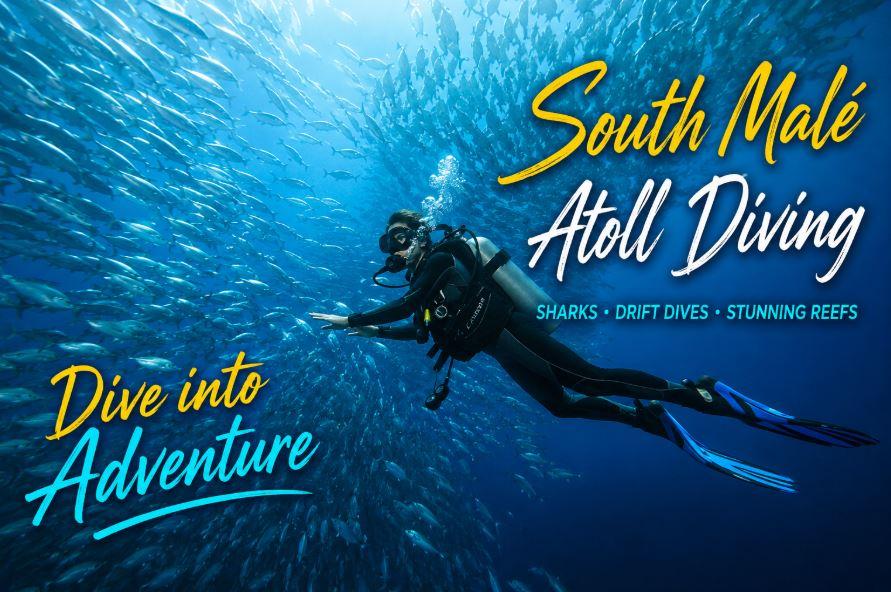
Just south of the Maldivian capital lies one of the country’s most exciting underwater playgrounds. South Malé Atoll diving is famous for fast-moving channel dives, dramatic reef formations, colorful soft corals and encounters with grey reef sharks, eagle rays, Napoleon wrasse and huge schools of tropical fish.
From the adrenaline-filled Kandooma Thila to the protected waters around Guraidhoo Kandu, South Malé Atoll combines classic Maldivian scenery with dives that can become seriously adventurous when the current starts running.
Why Dive in South Malé Atoll?
South Malé Atoll is particularly attractive to divers who enjoy variety.
Its underwater landscape includes kandus (channels), thilas (submerged pinnacles), reef walls, caves, overhangs and wrecks. Ocean currents passing through the channels bring nutrient-rich water into the atoll, attracting schooling fish and larger predators.
That means a single diving trip can include encounters with:
-
Grey reef sharks
-
Whitetip reef sharks
-
Eagle rays
-
Napoleon wrasse
-
Giant trevally
-
Barracuda
-
Tuna
-
Moray eels
-
Sea turtles
-
Batfish
-
Snappers and fusiliers
-
Manta rays on seasonal encounters
The strength of the currents varies significantly between sites and according to tides, making proper dive planning important.
Best Dive Sites in South Malé Atoll
1. Kandooma Thila
Kandooma Thila is one of the signature dives of South Malé Atoll.
This submerged pinnacle rises from deeper water and can deliver spectacular pelagic action when the current is flowing.
Divers may encounter grey reef sharks, eagle rays, tuna, giant trevally and enormous schools of fusiliers around the reef.
Overhangs and coral-covered sections add plenty of smaller marine life to the experience.
Because currents can range from moderate to extremely strong, Kandooma Thila is generally more appropriate for experienced divers.
2. Guraidhoo Kandu
Guraidhoo Kandu is much more than a single dive site.
The protected marine area contains two primary channels — Lhosfushi Kandu and Guraidhoo Kandu — separated by the Medhu Faru reef system.
The area was officially designated as a protected area in 1995 and covers approximately 352 hectares.
Incoming currents can produce excellent visibility and opportunities to encounter grey reef sharks, eagle rays and Napoleon wrasse.
The area's combination of channels, corners, reef slopes and overhangs means divers can return several times and experience something different on each dive.
3. Cocoa Corner
Cocoa Corner delivers the classic combination that makes Maldivian channel diving so addictive: current, reef structure and big marine life.
The site features caves and overhangs, while surrounding waters may hold grey reef sharks, eagle rays, sweetlips and schooling snappers.
Conditions can change substantially according to the current, so experienced local guides normally determine the best entry and exit points based on the tide.
4. Embudu Kandu
For experienced drift divers, Embudu Kandu can be one of South Malé Atoll's most exhilarating underwater adventures.
Strong currents sweep divers along the channel, creating opportunities to see grey reef sharks, whitetip reef sharks, large groupers and Napoleon wrasse.
The combination of depth and potentially powerful current makes this a dive where experience and excellent buoyancy control matter.
5. Kuda Giri Wreck
Not every dive in South Malé Atoll needs to involve racing through a channel.
Kuda Giri Wreck offers a completely different experience.
The small steel wreck rests at approximately 20–30 metres and has developed into an artificial habitat for marine life.
Batfish and other reef species can appear around the wreck, while the nearby pinnacle provides opportunities to search for smaller creatures such as nudibranchs.
It can be an excellent choice for photographers and divers looking for a change from the atoll's more demanding channel dives.
6. Kandooma Caves
Underwater topography becomes the attraction at Kandooma Caves.
A series of large caves and overhangs creates an atmospheric reef landscape decorated with marine growth.
Divers can search the darker sections for moray eels while reef fish cruise outside.
The site demonstrates that South Malé Atoll isn't only about sharks — its underwater architecture can be equally impressive.
7. Vaadhoo Caves
Vaadhoo Caves features a collection of caves and reef formations decorated with gorgonians, whip corals and other marine growth.
Current conditions can vary considerably, potentially transforming a relatively comfortable dive into something considerably more demanding.
For that reason, your dive guide's assessment of the day's conditions should always take priority.
Sharks in South Malé Atoll
Shark encounters are one of the biggest reasons experienced divers are drawn to South Malé Atoll.
Rather than actively searching across an enormous area, divers can position themselves around channel entrances and current-swept corners where predators naturally patrol.
Grey reef sharks and whitetip reef sharks are among the species divers may encounter.
Guraidhoo's protected reef system, for example, is known for encounters with sharks, eagle rays and Napoleon wrasse when conditions are favorable.
However, these remain wild-animal encounters. No dive site can guarantee a particular species.
Drift Diving in South Malé Atoll
If you've never experienced a Maldivian drift dive, South Malé Atoll provides a dramatic introduction.
Instead of swimming against the water, divers generally move with the current.
The boat then collects the group after they surface.
When conditions are suitable, the sensation of effortlessly flying alongside a reef can be extraordinary.
But current strength can change quickly.
Some South Malé sites therefore require experience with:
Drift diving, negative entries, controlled descents, current awareness, reef hooks where permitted and appropriate, and deploying a surface marker buoy.
Listen carefully to your divemaster's briefing before entering the water.
Best Time to Dive South Malé Atoll
South Malé Atoll can be dived throughout much of the year, but underwater conditions change with the Maldives' seasonal monsoons.
December to April
The northeast monsoon generally brings some of the clearest conditions to many eastern-facing dive areas.
This period is popular with divers seeking good visibility and exciting channel dives.
May to November
The southwest monsoon can bring more variable weather and underwater visibility.
However, increased plankton activity in parts of the Maldives can also create opportunities for encounters with larger filter feeders, including manta rays.
Rather than choosing a season based only on weather, consider what marine life and type of diving you most want to experience.
Is South Malé Atoll Suitable for Beginners?
Yes — but beginners should not attempt every dive site.
South Malé Atoll contains sheltered reefs and relatively manageable locations alongside powerful channels suitable primarily for experienced divers.
Sites such as Kuda Giri Wreck may provide more accessible conditions when currents are mild, while dives such as Embudu Kandu and certain Kandooma or Guraidhoo dives can demand significantly more experience.
A reputable dive center will select sites according to your certification, number of logged dives and comfort in currents.
Tips for Diving South Malé Atoll
A few preparations can make the experience considerably better.
Do a check dive first. If you haven't been diving recently, begin somewhere relatively sheltered before attempting strong-current channels.
Consider Nitrox. Certified Nitrox divers may benefit on repetitive dives, particularly when profiles involve significant time around 18–30 metres.
Bring an SMB. A surface marker buoy is especially important when drift diving.
Follow the current, not your ego. Trying to fight a powerful Maldivian channel current can quickly consume your air and energy.
Listen to local guides. Tide and current direction can completely change how the same dive site behaves.
South Malé Atoll vs North Malé Atoll
Both atolls offer excellent diving, but their personalities can feel different.
South Malé Atoll particularly appeals to divers searching for current-driven channel dives, pelagic encounters and exhilarating drift diving.
Its proximity to North Malé Atoll also makes combining the two areas relatively easy.
For divers staying longer, South Malé can also form part of broader liveaboard itineraries continuing toward Vaavu and Ari Atolls.
Underwater Photography in South Malé Atoll
Wide-angle photographers should find plenty of inspiration here.
Potential subjects include sharks cruising along channel edges, eagle rays moving through blue water, enormous schools of fish surrounding pinnacles and divers drifting past coral-covered walls.
A wide-angle setup is especially useful for the larger marine life.
Macro photographers shouldn't ignore the reefs, however. Slower dives around wrecks, pinnacles and sheltered reef sections can reveal nudibranchs and other smaller creatures.
Strong currents can make photography difficult, so maintaining buoyancy and situational awareness should always come before getting the shot.
Responsible Diving in South Malé Atoll
South Malé's reefs are living ecosystems and should be treated accordingly.
Never stand on or deliberately touch coral. Maintain good buoyancy, secure dangling equipment and avoid chasing turtles, rays or sharks for photographs.
Inside protected areas such as Guraidhoo Kandu, following local regulations and your dive operator's instructions is especially important.
The goal is simple: enjoy the marine environment without changing it.
Is South Malé Atoll Worth Diving?
Absolutely.
For divers who picture the Maldives as sharks cruising through blue water, eagle rays soaring over reef edges and huge schools of fish surrounding coral-covered pinnacles, South Malé Atoll delivers exactly that kind of experience.
Its strongest dives can be challenging, but that's part of the attraction.
Combine spectacular reef scenery with powerful channels, wrecks, caves and an impressive variety of marine life, and South Malé Atoll easily earns its reputation as one of the Maldives' essential scuba-diving destinations.
Frequently Asked Questions About Diving in South Malé Atoll
What is South Malé Atoll famous for diving?
South Malé Atoll is particularly famous for channel and drift diving, with opportunities to encounter grey reef sharks, whitetip reef sharks, eagle rays, Napoleon wrasse, trevally and large schools of reef fish.
What are the best dive sites in South Malé Atoll?
Popular sites include Kandooma Thila, Guraidhoo Kandu, Cocoa Corner, Embudu Kandu, Kuda Giri Wreck, Kandooma Caves and Vaadhoo Caves.
Can beginners dive in South Malé Atoll?
Yes. Some locations can suit beginner and intermediate divers when conditions are calm. However, many famous channel dives experience strong currents and are better suited to experienced divers.
Can you see sharks in South Malé Atoll?
Yes. Grey reef sharks and whitetip reef sharks are among the sharks divers may encounter, particularly around channels and current-swept reef corners.
Can you see manta rays?
Manta rays can be encountered seasonally, although sightings depend on conditions and should never be guaranteed.
When is the best time to dive South Malé Atoll?
Diving is possible across much of the year. December through April is particularly popular for generally favorable visibility and northeast-monsoon diving conditions, while the southwest monsoon brings different conditions and seasonal marine-life opportunities.
Is South Malé Atoll good for advanced divers?
Yes. In fact, experienced divers may get the most from the atoll because several of its signature locations involve strong currents, deeper profiles and exhilarating drift dives.
Should I use Nitrox?
Nitrox can be useful for repetitive diving and profiles that spend considerable time at moderate depths. You must be appropriately certified and follow your dive operator's procedures.
Is Guraidhoo Kandu protected?
Yes. Guraidhoo Kanduolhi is an officially designated protected area, protected since September 1995.
Is South Malé Atoll better than North Malé Atoll?
Neither is universally better. South Malé is particularly attractive for divers who prioritize drift dives, channels and pelagic action, while combining North and South Malé can provide an even broader Maldives diving experience.

 Dhivehi
 English
 Arabic
 French
 Spanish
 Portuguese
 Deutsch
 Dutch
Dutch
 Italiano
 Russian
 Romaian
 Portuguese (Brazil)
 Greek
Greek